
Northern Virginia (NOVA) is one of the nation’s strongest real estate markets, supported by proximity to Washington, D.C., a solid job base, and steady population growth. Investors can tap into opportunities ranging from suburban single-family rentals to multifamily and commercial projects, but success depends on understanding local market dynamics and choosing financing that fits NOVA’s competitive environment.
LendSure Home Loans offers flexible financing solutions built for Northern Virginia investors. Whether you’re acquiring your first rental property or scaling an existing portfolio, exploring financing programs tailored to NOVA’s market realities—rather than traditional lending limitations—can help you secure deals quickly and support long-term wealth building.
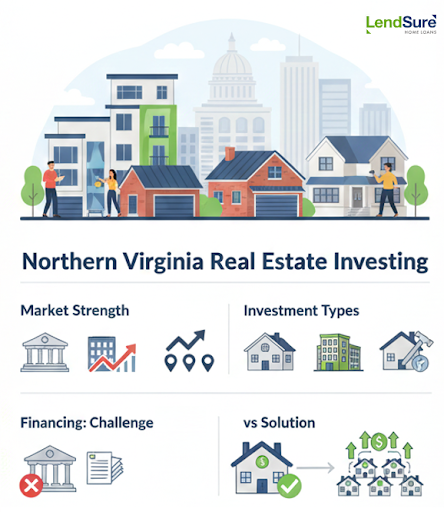
The Northern Virginia Investment Appeal
Northern Virginia’s market is fueled by federal employment, defense contracting, and a growing tech sector—creating high-income households and strong, stable rental demand. Population growth consistently exceeds national averages, with Arlington, Alexandria, and Loudoun County among the fastest-growing areas.
Home values historically appreciate faster than the national average, with Arlington and Alexandria showing steady long-term gains and Loudoun County offering strong growth at comparatively lower entry prices. However, NOVA’s strength also brings higher acquisition costs, often $400,000–$600,000+, making financing partners familiar with the region’s price points and property types essential.
NOVA Rental Market Dynamics
Urban Core (Arlington & Alexandria)
These walkable, high-demand areas command premium rents thanks to federal workers and corporate relocations. Two-bedroom single-family rentals often reach $2,200–$3,500 per month, while multifamily units rent for $1,500–$2,300 depending on amenities and proximity to transit.
Suburban Markets (Fairfax & Prince William Counties)
Rents are more moderate—typically $1,600–$2,400 for single-family homes—but lower acquisition costs improve cash-on-cash returns. These areas attract families seeking strong schools and suburban amenities, resulting in stable, longer-term tenants.
Employment & Innovation Corridors
Areas along Route 29, the Dulles Technology Corridor, and the I-81 corridor continue to grow as companies expand or relocate nearby. These mixed-use and emerging submarkets offer opportunities for investors positioned ahead of corporate or infrastructure development.
Year-Round Income Stability
Because NOVA’s economy isn’t seasonal, rental demand stays steady throughout the year. This consistent cash flow strengthens the appeal of DSCR financing, which relies on reliable property-level income for qualification.
Property Types and Investment Strategies in Northern Virginia
Northern Virginia’s diverse landscape accommodates multiple investment strategies. Buy-and-hold single-family rentals work well in suburban markets where appreciation and rental income combine for solid returns.
Multifamily operators can acquire 4–12 unit buildings in established neighborhoods. Fix-and-flip strategies appeal to investors in emerging submarkets—renovated properties sell quickly at premium prices, supporting profitable cycles.
Northern Virginia Financing Challenges
High purchase prices in Northern Virginia push properties into jumbo loan territory, where conventional financing becomes expensive or unavailable. Many traditional lenders cap loans at $3 million or less, limiting portfolio expansion in NOVA. Conventional lenders also struggle with mixed-use properties, multifamily buildings with unusual structures, and development-phase neighborhoods with limited comparable sales data.
For investors managing multiple Northern Virginia properties, debt-to-income ratios compound the challenge. Each property’s rental income counts toward cumulative DTI, quickly limiting additional financing as portfolios expand.
DSCR Financing for Northern Virginia Investors
DSCR loans remove the traditional barriers of personal income and DTI calculations by focusing solely on whether a property’s rental income covers its debt. This makes scaling in Northern Virginia far more accessible, especially for investors targeting multifamily or mixed-use assets. For example, a 6-unit building earning $144,000 annually with $115,000 in debt obligations qualifies at a 1.25x DSCR—no personal income documentation required.
High-Cost Market Financing Made Easier
NOVA’s higher purchase prices are no longer a limitation. DSCR loans offer up to $3 million for 1–4 unit properties and up to $2 million for 5–10 unit buildings, supporting acquisitions across Arlington, Alexandria, Fairfax, and Loudoun County. Because each property qualifies on its own cash flow, portfolio growth isn’t capped by cumulative DTI.
Flexible Refinancing for Growth
Refinancing with DSCR programs allows investors to unlock equity from appreciated NOVA properties without income reverification. This supports both rate-and-term improvements and cash-out refinances—funding additional acquisitions and accelerating portfolio expansion.
Market-Specific Underwriting for Northern Virginia Properties
DSCR lenders experienced with Northern Virginia understand the region’s specific market dynamics. Rental income documentation for properties in NOVA includes lease agreements, tenant deposit records, property management statements, and collected rent—straightforward documentation reflecting real operational performance.
For Northern Virginia’s high-value and emerging-market properties, DSCR lenders use both comparable sales and income-based valuations. This allows new construction and repositioned assets to qualify even when traditional appraisals fall short. By relying on projected occupancy, market rents, and similar developments, DSCR lenders can finance properties that conventional lenders decline. LendSure also supports mixed-use and specialty assets, expanding investment opportunities across NOVA.
DSCR Loan Terms for NOVA Portfolio Building
LendSure designs DSCR loans around real Northern Virginia investment needs. Ratios start at 1.0x for strong cash-flowing properties, with flexibility down to 0.75x—and even 0.25x in select cases—for investors pursuing tighter-margin deals or emerging NOVA submarkets.
Leverage & Cash Flow Advantages
For 1–4 unit properties, financing reaches 85% LTV on purchases, 80% on rate-and-term refinances, and 75% on cash-out refinances. For 5–10 unit buildings, LTVs run up to 75% on purchases and 65% on cash-outs. LendSure also offers 40-year terms with 10 years of interest-only payments, a major advantage in NOVA’s high-price markets by reducing early debt service and freeing capital for improvements or additional acquisitions.
Investors can finance unlimited NOVA properties, with the ability to close multiple loans at once—ideal for rapidly scaling portfolios in competitive submarkets.
Tax and Financial Planning Considerations
NOVA rentals offer strong tax benefits—depreciation, operating expenses, mortgage interest, and management deductions—but these reduce taxable income and make tax returns understate true cash flow. A tax professional can help you understand how these deductions fit into your broader financial plan.
DSCR financing keeps all tax benefits intact while evaluating income based on actual revenue, not tax-reduced figures—crucial in a high-cost market like Northern Virginia. For example, a property earning $36,000 annually with $30,000 in debt obligations still qualifies at a 1.2x DSCR, reflecting real cash flow rather than diluted taxable income.

Building Your NOVA Real Estate Portfolio
Successful investing in Northern Virginia starts with aligning your financing to your strategy. DSCR loans support rapid portfolio growth by removing DTI limits and allowing unlimited financed properties—ideal for buy-and-hold investors. Fix-and-flip investors can use DSCR construction or bridge loans for fast acquisitions and short project timelines.
Key Portfolio Strategies in NOVA:
- Urban core focus (Arlington, Alexandria): steady appreciation and strong tenant demand
- Emerging markets (Loudoun County, tech corridors): lower entry prices and higher cash-on-cash returns
- Blended approach: mixing mature and emerging markets for both stability and growth
Partnerships and syndications are also common in NOVA. DSCR financing supports multiple ownership structures, qualifying based on property performance rather than each partner’s personal financial profile.
Comparing Financing Options for NOVA Acquisitions
Your best financing path depends on property type and strategy. Conventional loans may suit buyers with strong personal income purchasing a single residence, but they offer limited flexibility for investors navigating NOVA’s higher prices and diverse property types.
For most NOVA investors, DSCR financing provides clear advantages: properties with complex characteristics can qualify using rental income and market analysis, portfolio growth isn’t restricted by cumulative DTI, and refinances for equity or better terms don’t require income reverification. In a high-cost market like Northern Virginia, this flexibility allows your investment strategy—not lender limits—to drive your acquisitions.
Contact LendSure to explore financing options tailored to your NOVA investment goals, whether you’re purchasing your first rental, expanding a portfolio, or refinancing for strategic growth.
FAQs
What makes Northern Virginia attractive for real estate investors compared to other markets?
NOVA’s stable federal government employment, growing technology sector, and consistent population growth create strong, predictable rental demand. Property appreciation historically exceeds national averages, particularly near Washington D.C. and employment corridors. The region’s year-round rental income stability supports strong cash flow for both single-family and multifamily investments.
Can I qualify for DSCR financing on a NOVA property with limited rental history?
Yes. New or recently acquired NOVA properties can qualify using lease agreements, property management projections, comparable rental rates for similar NOVA properties, and realistic occupancy assumptions. DSCR lenders evaluate income potential, not just documented history.
How do high property purchase prices in Arlington and Alexandria affect DSCR loan qualification?
DSCR loans extend up to $3 million for 1–4 unit properties, accommodating NOVA’s higher-priced markets. Qualification is based on the property’s rental income, not the purchase price—so premium-priced NOVA properties qualify the same way as lower-priced properties, as long as rental income covers debt obligations.
What’s the advantage of DSCR refinancing for my NOVA investment property?
DSCR rate-and-term refinances (up to 80% LTV) enable capturing favorable terms, while cash-out refinances (up to 75% LTV) extract equity from appreciated NOVA properties without requiring personal income reverification. This enables strategic portfolio management and capital deployment for additional acquisitions.
Can I finance multiple NOVA properties simultaneously through DSCR programs?
Yes. LendSure permits multiple simultaneous closings and manages unlimited financed properties per investor—ideal for NOVA portfolio builders acquiring several rental properties across different submarkets quickly.
How does DSCR handle mixed-use or multifamily properties in NOVA’s development-phase neighborhoods?
DSCR lenders with NOVA experience evaluate these properties using forward-looking market analysis, comparable lease rates in similar NOVA developments, and projected occupancy rather than relying solely on limited comparable sales. This enables financing for properties conventional lenders decline.
What DSCR ratio do I need for a NOVA multifamily property to qualify?
Standard qualification begins at 1.0x DSCR, so properties with break-even cash flow still qualify. LendSure often permits ratios down to 0.75x for NOVA properties with developing markets or tighter margins, with exceptions to 0.25x in select situations.
How quickly can I close a DSCR loan for a NOVA property acquisition?
DSCR loans typically close within 2–3 weeks because qualification focuses on property cash flow and credit evaluation—not personal income documentation, complex DTI calculations, or extensive underwriting delays common with conventional lenders.