
Real estate investors in Georgia face a persistent financing gap. Traditional lenders demand extensive personal income documentation, two-year rental histories, and strict debt-to-income calculations that constrain portfolio growth. For investors acquiring rental properties quickly, managing multifamily buildings, or building diversified portfolios across Georgia’s markets, conventional financing creates barriers rather than opportunities.
LendSure Home Loans bridges this gap with DSCR (Debt Service Coverage Ratio) loan programs designed specifically for Georgia investors. Rather than forcing your acquisition strategy into traditional lending frameworks, DSCR financing aligns with how investment properties actually perform—evaluating each property’s cash flow as the primary qualification metric.
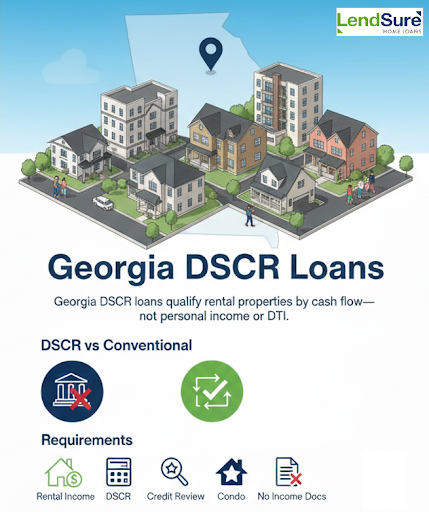
What Separates DSCR From Conventional Georgia Lending
Conventional loans evaluate rental properties through your personal finances—requiring W-2s, tax returns, bank statements, and cumulative DTI calculations across every property you own. This framework assumes your job income should carry the debt, not the rental property itself, which limits how quickly Georgia investors can scale.
DSCR loans flip that model. Qualification is based on whether the property’s rental income can cover its payment. Personal income documents become secondary, tax returns aren’t central, and each property qualifies on its own cash flow. This removes the cumulative DTI ceiling, allowing Georgia investors to finance a second, third, or tenth property without being limited by personal income constraints.
Core Georgia DSCR Requirements
DSCR qualification relies on one metric: annual rental income divided by annual debt. A property earning $48,000 with $40,000 in debt carries a 1.2x DSCR—your primary qualification factor, not personal income. Most Georgia loans start around 1.0x, with LendSure often approving down to 0.75x and, in select cases, as low as 0.25x for investors pursuing tighter-margin or emerging-market deals.
Credit & Leverage Guidelines
Credit is reviewed for reliability (typically 660+), but unlike conventional loans, DTI doesn’t matter. LendSure also offers strong leverage: up to 85% LTV for 1–4 unit purchases, 80% for rate-and-term refinances, and 75% for cash-out refinances. For 5–10 unit buildings, LTVs run up to 75% on purchases and 65% on cash-outs, with loan amounts reaching up to $3 million—supporting everything from suburban Atlanta rentals to small Georgia multifamily assets.
Income Documentation That Actually Works for Georgia Investors
DSCR lenders evaluate rental income based on real property performance. Active Georgia rentals can qualify using platform reports, property management statements, bank deposit records, signed leases, and landlord affidavits documenting rent amounts and occupancy. This gives a clearer picture of true cash flow than traditional income methods.
For properties without rental history, LendSure accepts market analyses, comparable rental data, and executed leases to document income potential—no multi-year history required. Tax returns and Schedule E filings become secondary, since DSCR lenders focus on gross rental revenue before deductions, not the reduced taxable income conventional lenders rely on.
Non-Traditional Georgia Properties: Condotels, Mixed-Use & Specialty Assets
Conventional lenders often decline Georgia property types that fall outside standard underwriting—such as non-warrantable condos, buildings with rental restrictions, or properties that operate more like commercial assets. Yet many of these represent strong investment opportunities for Georgia investors.
Condotels & Resort Properties
Condotel units—common in North Georgia resort areas and coastal destinations like Jekyll Island or St. Simons—qualify under DSCR when rental income can be supported through comps and occupancy projections. DSCR lenders evaluate these properties based on cash-flow potential rather than traditional condo guidelines.
Mixed-Use Buildings
For mixed-use assets combining residential and commercial space, DSCR lenders separate each income stream (residential, retail, office), then calculate the combined revenue for DSCR qualification. A property producing $8,000 in residential rent and $3,000 in commercial rent qualifies on its total $11,000 monthly income.
Vacation Rental Portfolios
Airbnb and Vrbo-based portfolios also qualify through DSCR programs using platform performance reports, occupancy data, and nightly rates. LendSure’s flexible documentation standards make financing possible for property types and strategies conventional lenders prohibit.
Interest-Only Terms and Cash Flow Advantages
Georgia property prices span a wide range—from affordable rental properties in rural areas to premium Atlanta acquisitions. DSCR’s interest-only flexibility adapts to this diversity. LendSure structures 40-year loan terms with 10-year interest-only periods, meaning your first decade of payments covers only loan interest, not principal reduction.
How Interest-Only Improves Cash Flow
This structure significantly improves monthly cash flow—especially useful in Georgia’s tighter-margin or value-focused markets. Lower early payments free capital for renovations, tenant acquisition, or additional property purchases. Once the interest-only period ends, payments then adjust to amortize the remaining principal over the rest of the term.
Investors can also structure interest-only periods shorter than 10 years if preferred—5 or 7-year interest-only options—or transition to standard amortization sooner. DSCR flexibility accommodates your specific cash flow management and portfolio strategy rather than imposing standardized structures.
Understanding Interest Rates and Pricing Factors
DSCR loan pricing in Georgia depends on several property-specific factors. A higher DSCR ratio typically earns better rates—a property at 1.5x DSCR will price more favorably than one at 1.0x. Credit score also matters, with borrowers in the 750+ range receiving stronger terms than those around 660–700. Loan amount and LTV can further influence pricing.
The key difference from conventional loans is that DSCR pricing is property-centric. Your rental property’s cash flow and the loan’s risk profile drive the rate—not your personal income or full financial picture.
Building Georgia Portfolios: Strategy and Execution
DSCR financing enables true portfolio scaling in Georgia. Investors can close multiple loans at once, finance unlimited properties, and grow without recalculating personal DTI after each acquisition.
Buy-and-Hold Strategies Across Georgia
Buy-and-hold investors benefit most from DSCR’s unlimited property capacity. Some target Atlanta’s high-appreciation neighborhoods for long-term wealth, while others focus on secondary markets with lower acquisition costs and stronger cash-on-cash returns. Many blend both approaches to balance stability and growth.
Fix-and-Flip Opportunities
Fix-and-flip investors leverage DSCR construction or bridge loans for rapid acquisitions and fast turnarounds. Georgia’s active rehab market—especially in emerging neighborhoods—supports profitable flip cycles where improvements significantly boost value.
Multifamily & Partnership Growth
Multifamily operators can steadily acquire 4–12 unit buildings without DTI limits restricting expansion. DSCR programs also support syndications and partnerships, qualifying based on property performance rather than each partner’s personal financials.
Addressing Common Georgia DSCR Objections
Prospective Georgia investors sometimes hesitate about DSCR financing due to misconceptions about rates, flexibility, or qualification barriers. Understanding common objections clarifies whether DSCR serves your specific investment goals.
Objection: “DSCR rates are higher than conventional financing.”
DSCR rates depend on property cash flow, borrower credit, and loan structure. Properties with strong DSCR ratios (1.5x or higher) often price competitively with conventional loans, while lower ratios (around 0.75x) carry slightly higher rates due to increased risk. For investors who can’t qualify conventionally because of portfolio size or income documentation limits, DSCR programs offer competitive pricing that reflects value—not penalty rates.
Objection: “I lose flexibility with DSCR loans compared to conventional mortgages.”
DSCR programs typically impose fewer restrictions on property use, rental strategy, and refinancing frequency than conventional loans. Interest-only periods, multiple simultaneous closings, and unlimited property financing create flexibility that conventional lenders simply don’t offer. Georgia investors building portfolios rapidly find DSCR’s flexibility enables strategies impossible under conventional frameworks.
Objection: “DSCR qualification is unpredictable or subjective.”
DSCR qualification relies on straightforward math: property income divided by debt obligations. While individual lender approaches vary, the core metric remains objective. Georgia investors can calculate their own DSCR before approaching lenders, understanding precisely how their properties qualify.
Contact LendSure to discuss whether DSCR financing aligns with your Georgia real estate strategy and portfolio goals.
Georgia DSCR Financing: Unlocking Your Investment Potential
DSCR loans eliminate the personal-income barriers that restrict conventional lending, allowing properties to qualify based on actual cash flow. This enables investors to scale across Georgia’s markets—from appreciating Atlanta neighborhoods to high–cash-flow secondary areas.
Whether you’re buying your first rental, expanding a portfolio, or refinancing for strategic advantage, LendSure’s DSCR programs support decisions aligned with your goals—not lender limitations. Choosing the right financing partner is key to accelerating your Georgia investment growth.
FAQs
What credit score do I need to qualify for a Georgia DSCR loan?
DSCR programs typically work with credit scores around 660 or higher, though individual circumstances vary. Credit review focuses on your borrower reliability and payment history rather than calculating whether your personal income covers the mortgage payment.
Can a new Georgia rental property with no rental history qualify for DSCR financing?
Yes. New properties can qualify using executed lease agreements, comparable rental market analysis from similar Georgia properties in the same market, realistic occupancy projections, and property management company rental estimates. Documented income potential qualifies immediately without requiring years of operational history.
How much can I borrow for a Georgia DSCR loan?
DSCR loan amounts extend up to $3 million for 1–4 unit Georgia properties, accommodating single-family rentals and small multifamily buildings. For 5–10 unit Georgia multifamily properties, loan amounts reach up to $2 million. Minimum loan amounts often start around $75,000.
What DSCR ratio do I need for my Georgia investment property?
Standard qualification begins at 1.0x DSCR, meaning break-even properties still qualify. LendSure frequently permits ratios down to 0.75x for Georgia markets with developing rental income or seasonal patterns. In select situations, ratios as low as 0.25x may be approved.
Can I finance multiple Georgia properties simultaneously with DSCR loans?
Yes. LendSure permits multiple simultaneous loan closings and manages unlimited financed properties per investor—ideal for Georgia investors acquiring several rental properties across different markets rapidly.
What documentation does LendSure require for Georgia rental income?
Documentation depends on the property stage. Operating properties submit lease agreements, property management statements, bank deposit records showing collected rent, and landlord affidavits. New properties use comparable market rental analyses, executed leases, and occupancy projections.
What interest-only terms are available for Georgia DSCR loans?
LendSure offers 40-year terms with 10-year interest-only periods as standard. Shorter interest-only periods (5 or 7 years) are also available, depending on your cash flow preferences and portfolio strategy.
How quickly does a Georgia DSCR loan close?
DSCR loans typically close within 2–3 weeks. Because the qualification focuses on property cash flow and credit evaluation rather than extensive personal income documentation, the process moves efficiently from application to funding.