Buying a new home before your current one sells is one of the most common timing challenges in real estate — and a bridge loan is one of the most practical tools for navigating it. Like any financing product, bridge loans come with genuine advantages and real considerations worth understanding before you commit. Knowing both sides helps you decide whether it’s the right fit for your situation.
LendSure Home Loans offers theBOOST Bridge Loan program, a short-term financing solution designed to address the most common friction points of a standard bridge loan. This guide covers how bridge loans work, where they shine, where they require planning, and how BOOST is structured to make the transition between properties as smooth as possible.
What Is a Bridge Loan?
According to federal lending guidance, bridge loans are temporary financing products typically lasting 12 months or less, designed to help borrowers transition between two financing events. In a home purchase context, the loan taps the equity in your existing home — paying off the current mortgage and releasing remaining equity as cash toward your new purchase — before the first property sells.
The result is immediate liquidity from an asset you already own, without waiting for a sale to close. Rather than piecing together financing workarounds to access that equity, a bridge loan is purpose-built for exactly this transaction.
The Pros of Bridge Loans
You Can Move on a New Home Without Waiting
The most immediate advantage is timing. A bridge loan removes the dependency between buying and selling — you don’t have to wait for your current home to sell before making a move on the next one. In a market where desirable properties move quickly, that freedom is significant.
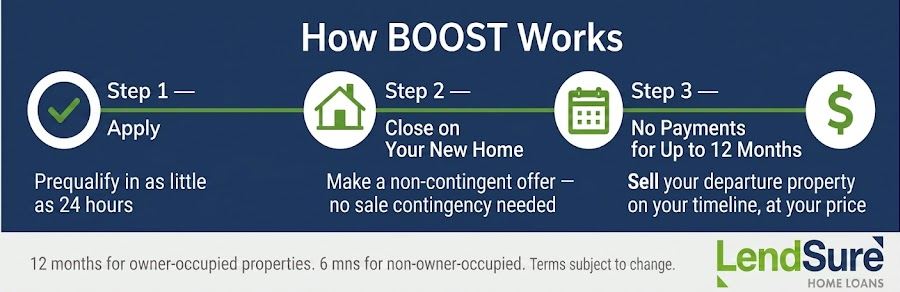
With LendSure’s BOOST program, prequalification can happen in as little as 24 hours and full conditional approval typically within 48–72 hours — fast enough to position you competitively when the right property comes available.
You Can Make a Non-Contingent Offer
A contingent offer — one that depends on your current home selling first — is often a disadvantage in a competitive market. Sellers prefer buyers who can close cleanly and quickly, and a sale contingency introduces uncertainty many sellers aren’t willing to accept.
BOOST allows you to make a non-contingent offer by funding your new purchase before your departure property sells. That makes your offer structurally stronger and more appealing, giving you a real chance against buyers who can close without conditions.
Your Equity Works for You Immediately
Your existing home likely holds meaningful equity — and a bridge loan puts that equity to work before the sale closes. Rather than leaving it tied up in a property you’re planning to sell anyway, you access it now to fund the next chapter.
This is a key distinction from other equity access methods, which often introduce variability in draw timing, amounts available, and DTI implications that complicate a purchase transaction. A bridge loan delivers a clean lump sum tied to a specific transaction — no revolving draw periods, no uncertainty about how much you can use at closing.
No Monthly Payments With BOOST
Most standard bridge loans require immediate repayment, which creates financial pressure during an already complex transition. LendSure’s BOOST program is structured differently — no monthly payments are required for up to 12 months for owner-occupied properties and 6 months for investment properties.
That breathing room lets you focus on the new home, take time to properly prepare and stage your departure property, and sell when the timing and market conditions work in your favor rather than under financial pressure.
No DTI Impact on Your New Purchase
BOOST refinances existing liens without affecting the debt-to-income ratio on the new home purchase. This means you qualify for the new mortgage without carrying the departing property’s debt in the calculation — a meaningful structural advantage over financing arrangements that count against your DTI while you’re still holding both properties.
The Cons of Bridge Loans — and How BOOST Addresses Them
Short Loan Terms Require a Sale Plan
Bridge loans are short-term by design. The balloon payment becomes due when your departure property sells or at the end of the loan term — whichever comes first. If your home takes longer to sell than expected, that timeline can create pressure.
BOOST gives owner-occupied borrowers up to 12 months to sell — enough runway in most markets to list, negotiate, and close without rushing. Going in with a realistic picture of local market conditions and a clear pricing strategy helps manage that timeline effectively.
Equity Requirements Must Be Met
A bridge loan works by paying off your existing mortgage and releasing remaining equity as cash. The amount available depends on your current loan balance relative to your property’s value — if equity is limited, the proceeds may not fully cover the new purchase needs.
LendSure supports loan amounts between $150,000 and $2 million, with up to 75% LTV for owner-occupied properties on loan amounts up to $1.5 million. Understanding your equity position before applying gives you a clear picture of what’s available.
Bridge Loans Carry Short-Term Financing Costs
As short-term products, bridge loans typically carry higher costs than long-term mortgage financing. This is the nature of any short-duration lending product — the trade-off for immediate access, speed, and flexibility is a higher cost relative to a 30-year fixed mortgage.
For most buyers, the ability to move on the right property now — rather than waiting months for a sale to close — is worth that cost. The key is going in with clear eyes about what the financing costs and how quickly you plan to sell.
Who a Bridge Loan Is Best Suited For
Bridge loans are a practical fit across several buyer profiles. Buyers in competitive markets who can’t afford to submit a contingent offer benefit most directly from the non-contingent offer capability. Buyers who want time to properly prepare their departure property — staging, minor repairs, strategic pricing — benefit from the no-payment structure that removes the urgency to sell immediately.
Self-employed buyers and borrowers with complex income documentation are also well served. BOOST works alongside LendSure’s full range of documentation options — including bank statement loans, full doc, and asset depletion — so the bridge financing and the new purchase loan can be structured together rather than separately.
LendSure’s BOOST: A Bridge Loan Built Around the Buyer
Standard bridge loans solve the timing problem but often create new pressure points — immediate repayment requirements, DTI complications, and tight qualification windows. BOOST is designed to remove those friction points while preserving the core advantage: access to your equity now, on a timeline that works for you.
The program supports a wide range of buyers and income documentation types, moves quickly from application to approval, and pairs with LendSure’s broader non-QM product suite for buyers whose financial profile doesn’t fit a conventional mold.
For buyers ready to move without waiting, contact LendSure Home Loans to explore your BOOST options.
Frequently Asked Questions
What is a bridge loan and how does it work?
A bridge loan is short-term financing that taps the equity in your current home to fund the purchase of a new one before your existing property sells. The loan pays off your current mortgage and releases remaining equity as cash toward the new purchase. It is repaid when your departure property sells or at the end of the loan term — typically within 12 months.
What are the main advantages of a bridge loan?
Bridge loans allow you to buy before you sell, make non-contingent offers, and access your existing equity immediately without waiting for a closing. LendSure’s BOOST program adds no monthly payments for up to 12 months and no DTI impact on the new purchase — addressing the most common friction points of a standard bridge loan structure.
What are the main risks of a bridge loan?
The primary consideration is timeline: the balloon payment is due at the end of the term or when the property sells. If your departure home takes longer to sell than expected, that creates financial pressure. Going in with a realistic picture of your market and a clear pricing strategy helps manage that risk. Equity requirements must also be met — the loan amount depends on how much equity you have relative to your current mortgage balance.
Do I need to make monthly payments on a bridge loan?
With LendSure’s BOOST program, no. No monthly payments are required for up to 12 months for owner-occupied properties and 6 months for investment properties. A single balloon payment is due when your departure property sells or at the end of the term.
Does a bridge loan affect my qualification for a new mortgage?
With BOOST, the bridge financing does not affect your debt-to-income ratio on the new home purchase. This is one of the key structural differences between BOOST and other short-term financing arrangements — you qualify for the new mortgage without the departing property’s debt counting against you.
Can self-employed borrowers use a bridge loan?
Yes. BOOST works alongside LendSure’s full range of income documentation options, including bank statements, full doc, and asset depletion. Self-employed buyers and borrowers with complex income structures can access bridge financing without needing to meet conventional documentation requirements.
How quickly can a bridge loan be approved?
LendSure can prequalify BOOST applications in as little as 24 hours, with full conditional approval typically within 48–72 hours. That speed is particularly valuable in competitive markets where buyers need to act quickly on a property.