
California real estate investors often face a crossroads when financing rental properties. Traditional lenders scrutinize personal income, tax returns, and credit history, while newer DSCR programs—like those offered by LendSure Home Loans—evaluate the property itself.
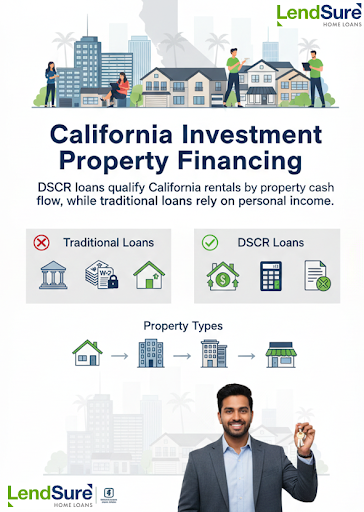
The Core Philosophy: Income vs. Asset
Traditional lenders focus on your personal financial profile. They want to see consistent W-2 income, clean tax returns for the past two years, strong credit scores, and documentation showing you can service the debt from your own earnings. The property serves as collateral, but your ability to pay comes from your day job.
DSCR loans flip this approach. Instead of evaluating your personal finances, lenders analyze what the property itself produces. If the property generates $3,000 in monthly rental income and the total debt service (mortgage payment, insurance, taxes, HOA fees) comes to $2,400, you have a DSCR of 1.25. The property pays for itself through tenant income, not your personal paycheck.
How California’s Rental Market Affects Your Financing Choices
California’s diverse real estate markets create underwriting challenges for both loan types. In coastal areas with thin cap rates, traditional lenders may hesitate even when properties are strong, simply because borrower income doesn’t match high purchase prices. Inland properties with stronger returns qualify more easily, but investors with multiple rentals often hit conventional limits on financed units.
DSCR loans bypass these issues by focusing on local rental income rather than borrower location or employment. A self-employed investor in San Francisco and a remote worker in San Diego face identical DSCR criteria, making this option especially useful for California investors with mixed portfolios across markets and property types.
Documentation Requirements: Where Traditional and DSCR Diverge
Traditional lenders demand extensive personal documentation: two years of tax returns, W-2s or 1099s, pay stubs, bank statements, profit and loss statements for self-employed borrowers, and sometimes accountant letters. The process takes weeks and leaves little room for flexibility if documentation appears inconsistent.
DSCR underwriting centers on property income, using leases, bank statements, or management reports for verification. Because California rentals often involve furnished units, corporate housing, or mixed-use properties, additional clarification is sometimes needed. LendSure works with borrowers to document actual rental operations rather than forcing conventional structures.
Loan Amounts and Leverage: Finding Your Financing Limit
Traditional lenders typically cap investment property financing at four to six financed rental units per borrower, with loan amounts rarely exceeding $1–2 million per property. Debt-to-income ratios become the ceiling—no matter how profitable your properties are, your personal income limits how much you can borrow. This creates frustration for successful investors wanting to expand their portfolios without being constrained by unrelated income considerations.
DSCR programs offer different parameters. LendSure finances investment properties up to $3 million for one- to four-unit properties, with no limit on the number of financed properties. An investor with five, ten, or fifteen rental units can refinance or purchase additional properties as long as each deal meets its own DSCR threshold. This approach acknowledges that a portfolio investor’s strength lies in property diversity and cash flow, not personal W-2 income.
Credit Scores and Financial History Flexibility
Traditional lenders typically require credit scores of 680 or higher, with scores below 720 resulting in rate adjustments and additional documentation. Recent credit events—even those resolved successfully—trigger extra scrutiny that can delay or derail approval.
DSCR programs typically accept credit scores starting at 660, recognizing that strong real estate performance doesn’t always align with perfect credit. Investors with temporary credit issues but solid rental income may qualify through DSCR, while traditional lenders often require extensive explanations. This flexibility is especially valuable for California investors managing complex or seasonal business cash flow.
Speed and Certainty: Timeline Considerations
Traditional loan approval in California typically takes 45–60 days once all documentation is submitted. Missing documents, inconsistent tax returns, or complex income situations extend timelines further. Many California real estate transactions operate with tight closings, and a financing delay can cost you an off-market opportunity.
DSCR approvals move faster because lenders focus on property cash flow instead of detailed personal finances. With less income verification required, decisions come sooner, and LendSure provides term sheets quickly so investors can assess their options. This contrasts with traditional lending, which involves longer, document-heavy reviews.
Interest Rates and Program Costs: What to Actually Compare
Both traditional and DSCR loans in California operate in competitive markets, but rate structures differ. Traditional lenders evaluate personal creditworthiness when pricing loans. DSCR rates reflect property cash flow coverage; different DSCR ratios affect pricing based on how much cash flow cushion exists above debt service.
A DSCR loan on a property with 1.5x coverage structures pricing one way, while a property with 0.75x coverage (still acceptable with LendSure) structures pricing differently, reflecting the distinct risk profiles. Comparing costs between traditional and DSCR financing requires looking at your specific property situation and available options. Some properties qualify under both programs; others only qualify through one approach.
When Each Option Works Best in California
Choose traditional financing if you hold fewer than four rental properties, have W-2 employment or documented business income showing consistent profits, and prefer conventional underwriting processes that may be familiar to you.
Consider DSCR if you own multiple properties and want to evaluate financing options, have personal income that differs from your property portfolio structure, are self-employed or managing complex business finances, or have specific timelines for acquisitions. Each approach offers distinct advantages depending on individual circumstances.
Your Situation Assessment
Every investor’s financing path depends on specific circumstances that generalized comparisons miss. To help evaluate which approach might fit your California investment strategy, consider gathering information about your current portfolio and expansion plans.
Review Your Current Portfolio Metrics
Understanding your existing debt service coverage across owned properties shows how different programs evaluate your financial position. Calculating your current debt-to-income ratio with personal income sources clarifies how traditional lending guidelines would apply to your situation.
Organize Your Rental Income Documentation
Documenting how you currently verify rental income—through property management statements, bank deposit records, or lease agreements—indicates documentation availability for either program.
Evaluate Credit History and Recent Financial Events
Reviewing your credit timeline and recent financial events helps determine what traditional underwriting focuses on.
Clarify Your Acquisition Timeline
Finally, clarifying your timeline for the next acquisition identifies whether speed and flexibility matter for your specific transaction.
These details aren’t required upfront; instead, they become conversation starters with your lender to understand which program options match your circumstances.
LendSure’s California Investor Approach
LendSure brings a common-sense lending philosophy to California’s complex investment market. Rather than forcing borrowers into conventional templates, the team evaluates situations as they actually exist. A self-employed investor with inconsistent business income might qualify through DSCR because the property’s performance speaks for itself.
A portfolio investor wanting to exceed traditional financed property limits gets streamlined approvals without artificial ceilings. This flexibility—combined with willingness to make exceptions to standard guidelines—reflects the reality that successful California real estate investors operate outside conventional boxes.
FAQs
What DSCR ratio does LendSure require for California investment properties?
LendSure accepts DSCR ratios as low as 0.75, with exceptions available to 0.25 on a case-by-case basis. Rather than rigid minimums, the program evaluates each deal’s risk profile, property type, and borrower experience. This flexibility means properties with tighter cash flow still have financing options that traditional lenders completely eliminate.
Can I finance multiple California properties simultaneously with DSCR?
Yes. LendSure closes multiple DSCR loans for the same investor during the same transaction period. You’re not limited to refinancing or purchasing one property at a time, which means you can consolidate closings and potentially accelerate portfolio expansion timelines.
Does LendSure finance non-warrantable condos in California?
Non-warrantable condos are available for DSCR financing up to 75% LTV. This opens opportunities for California investors focused on condo conversions, vacation rental condos, or boutique properties that traditional lenders systematically decline despite solid cash flow fundamentals.
How does LendSure verify rental income differently from traditional lenders?
Instead of requiring two years of tax returns showing rental income, LendSure accepts lease agreements, property management statements, and recent bank deposits showing rent received. This documentation approach works particularly well for California investors with newer properties or recently stabilized rentals that don’t yet have long tax return histories.
What if my California property is currently vacant or being renovated?
DSCR programs offer flexibility for future income potential based on market rents and realistic lease-up timelines. Rather than requiring current occupancy or existing leases, LendSure evaluates underwritten rental income based on property type, location, and comparable market rents. This approach supports investors making strategic property transitions.
Can I use a DSCR loan for a California property I plan to eventually occupy as my primary residence?
DSCR loans are structured for investment properties where rental income services the debt. If you’re considering future owner-occupancy, traditional financing might better suit your long-term strategy. LendSure can discuss which option aligns with your actual timeline and intentions.
How does the DSCR application process work compared to traditional loan applications?
DSCR applications focus on property details, lease documentation, and rental income verification rather than extensive personal financial documentation. The streamlined process typically moves faster, with term sheets available within days. Traditional applications require comprehensive personal financial analysis, which provides more certainty for borrowers with strong profiles but takes longer overall.
What’s the maximum loan amount for California investment properties with LendSure?
LendSure finances up to $3 million for one- to four-unit properties. Five- to ten-unit properties carry different parameters. Beyond investment property financing, LendSure also offers jumbo loan options for borrowers with higher acquisition targets.