
Timeshares offer convenient vacation access, but they often lead to skepticism and regret. Instead of full ownership, you receive only fractional use—usually a week or two each year. LendSure Home Loans encourages buyers to understand what timeshares truly provide versus what they promise, so you can choose alternatives that offer real ownership and long-term value.
This guide examines timeshare fundamentals, their legitimate advantages, their significant drawbacks, and how they compare to alternative vacation property financing options. Whether you’re considering a timeshare purchase or exploring whether alternative investments better serve your goals, this educational overview helps you evaluate this complex market with clarity.
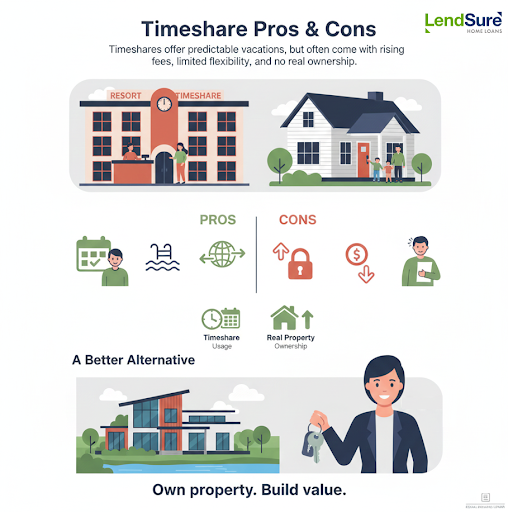
Timeshare Pros and Cons at a Glance
| PROS | CONS |
| Guaranteed annual vacation week (fixed-week model) | Escalating maintenance fees (3-5% annually) |
| Bundled amenities and services included | Illiquid—difficult and costly to sell |
| Global exchange networks expand vacation options | No equity building or property appreciation |
| Predictable planning for consistent travelers | Aggressive sales tactics and high-pressure environment |
| Resort community and social connections | Restrictive usage rules and blackout dates |
| All-inclusive convenience (no separate bookings) | Special assessments for major repairs |
| Some deeded ownership models include fractional equity | Limited exit options if circumstances change |
| Rental income often prohibited or restricted |
Understanding Timeshare Ownership Models
Deeded vs. Right-to-Use Timeshares
Timeshares come in two main forms, each with different legal and financial implications:
- Deeded Timeshares: You own a fractional share of the property for a set week each year, recorded in the deed. This offers limited equity protection and can be passed to heirs.
- Right-to-Use Timeshares: You receive a long-term license—typically 20–40 years—to use the property, but you never own the real estate. These operate more like long-term rental agreements.
Most modern timeshares are right-to-use because developers retain full ownership and avoid the complications of many deeded owners. While this structure benefits developers, it offers little equity or long-term value for buyers.
Fixed Week, Floating Week, and Points-Based Systems
Beyond ownership structure, timeshares operate on different usage models that affect your vacation flexibility. Fixed-week timeshares guarantee you the same calendar week annually, providing predictability and consistency. Floating-week timeshares allow you to book any available week within a season, giving flexibility but requiring advance planning and potentially facing availability competition from other owners.
Points-based systems represent the newest model, where you receive annual points that convert to various resorts, room sizes, and travel dates, functioning almost like vacation currency you manage year to year. Each system serves different travel patterns, and choosing the right model depends on your vacation habits and flexibility needs.
Timeshare Benefits and Limitations
The Genuine Appeal of Predictable Vacations
One real advantage of timeshares is the predictability they offer. A fixed-week ownership guarantees the same vacation week every year, avoiding hotel price spikes and availability issues. Families with school schedules or retirees who prefer routine often value this consistency. Timeshares also create a sense of belonging to a resort community—something traditional hotel stays can’t provide.
Bundled Amenities and Resort Services
Timeshares package accommodations and amenities into one structure. Maintenance fees usually cover housekeeping, property upkeep, recreational facilities, and in some cases activities or dining credits. This simplifies planning and delivers an all-in-one vacation experience. However, bundled costs aren’t necessarily cheaper—they’re simply organized differently, and the value depends on how much you use the included services.
Global Travel Through Exchange Networks
Exchange programs like RCI and Interval International allow owners to trade their week for stays at different resorts worldwide. This feature dramatically expands travel options, though it comes with planning requirements, fees, and occasional competition for availability.
Where Timeshares Fall Short Financially
Timeshares often disappoint when examined through a financial or investment lens. Rising maintenance fees, limited resale value, and the lack of equity buildup mean owners face ongoing costs with little long-term return. While the lifestyle benefits can be appealing, they don’t offset the financial drawbacks for most buyers.
Escalating Maintenance Fees
Maintenance fees rise annually—often 3–5%—meaning an $800 fee can easily exceed $2,000 over time. Resorts may also issue special assessments for major repairs, creating additional unexpected expenses. These rising costs are a major source of owner dissatisfaction.
The Challenge of Exiting Timeshare Ownership
Timeshares are notoriously difficult to sell. A purchase of $15,000 may later be worth only a fraction of that on the resale market, if a buyer can be found at all. Some owners resort to costly exit companies, and others simply abandon the property and face legal consequences. This lack of liquidity traps many owners in long-term financial obligations.
No Equity, No Appreciation
Timeshares don’t build equity or appreciate like traditional real estate. Owners purchase the right to use time, not the property itself. You cannot refinance, leverage equity, or pass meaningful assets to heirs. The long-term financial outcome is ongoing expense rather than wealth-building.
Aggressive Sales Tactics and Hidden Complexities
Timeshare sales presentations are often characterized by high-pressure tactics, emotional appeals, and limited-time “deals.” The sales environment reflects an industry reliant on urgency and persuasion, making it easy for buyers to commit without fully understanding long-term obligations.
DSCR Loans: Building Wealth Instead of Prepaying Vacations
Rather than prepaying for fractional usage rights, real estate investors can purchase actual rental properties financed through DSCR (Debt Service Coverage Ratio) loans. With DSCR financing, you qualify based on the property’s rental income rather than personal employment, allowing investors to finance income-generating properties. You build equity, receive tax benefits through depreciation, can refinance to access capital, and maintain complete control over your property.
LendSure Home Loans offers DSCR financing specifically designed for rental property investors, providing loan amounts up to $3 million for 1-4 unit properties with FICO scores as low as 660 and DSCR ratios as low as 0.75. Unlike timeshares where fees perpetually increase, DSCR loans feature fixed rates and predictable payments, allowing you to own appreciating assets rather than rights to depreciating usage.
Traditional Vacation Home Ownership
Purchasing an outright vacation home or condo provides complete ownership without the complexity of timeshare agreements or fractional rights. You control your property entirely, build equity, can rent it when not using it, and maintain flexibility around usage patterns. Financing options like traditional mortgages or bank statement loans (for self-employed borrowers) make vacation home ownership accessible to borrowers with various financial situations.
While vacation home ownership requires more active management than timeshare fractional rights, it provides genuine wealth-building rather than escalating fee obligations. You can also leverage your property for other financial purposes, whereas timeshares remain isolated vacation-only commitments.
Critical Questions Before Purchasing
If you’re seriously considering timeshare ownership, ask yourself these essential questions honestly. Can I commit to vacationing at the same resort regularly, or do I prefer travel variety? Am I comfortable with unknown future fee increases that could dramatically affect my budget? Do I understand the exit strategy if my circumstances change? Have I reviewed independent reviews from current owners rather than resort-provided testimonials? Would I still want this property if I had to pay cash for each vacation instead?
Honest answers to these questions often reveal that timeshares don’t align with actual needs and preferences, and that alternative vacation options serve your lifestyle better.
Red Flags in Timeshare Contracts
Avoid timeshares with vague maintenance fee schedules, restrictive usage limitations, high termination penalties, or unclear exit strategies. If a sales representative discourages you from reviewing documents independently or reading reviews before purchasing, treat that as a major warning sign. Legitimate vacation property options don’t require high-pressure sales tactics or complex contractual language designed to lock buyers in.
Contracts should clearly state all fees, usage rights, cancellation terms, and what happens to your ownership if you’re unable to pay. If this information isn’t transparent, walk away from the purchase.
Calculating True Ownership Costs
Calculate true timeshare costs realistically by adding purchase price plus annual maintenance fees multiplied by years of ownership, plus anticipated special assessments, plus exchange fees if you plan trading weeks. Most calculations reveal timeshares are expensive ways to commit to regular vacations when purchasing vacation homes or booking annually provides similar benefits with greater flexibility. Compare the total to alternative vacation spending patterns over the same timeframe.
This realistic math often shows that alternative vacation options—whether hotel stays, vacation home ownership, or DSCR-financed rental properties—provide better long-term value and fewer financial surprises.
Frequently Asked Questions
Can I rent my timeshare week to offset maintenance fees?
Many timeshare contracts prohibit rental income to third parties, eliminating this offset strategy entirely. Even contracts permitting rentals typically restrict income due to owner liability and resort policies. Timeshare rental income rarely covers annual fees, making this an unreliable expense mitigation strategy.
What happens if I can’t afford maintenance fees?
Non-payment leads to liens, foreclosure, and legal consequences that damage your credit long-term. Unlike mortgages where you can refinance or modify terms, timeshare obligations are extremely difficult to escape. Some owners default strategically, but this approach involves serious legal complications.
Are there legitimate timeshare exit companies?
Some exit companies provide genuine assistance, but many are scams targeting desperate owners seeking escape. Legitimate exits involve contract cancellation or legal challenges—expensive and time-consuming but sometimes necessary. Research thoroughly and verify credentials before engaging any exit company.
Is timeshare ownership ever a good investment?
Timeshares are vacation accommodations, not investments that appreciate or generate reliable income. They create perpetual expense obligations that increase annually. If someone is selling a timeshare as an “investment opportunity,” treat that claim with extreme skepticism.
How do timeshares compare to vacation home ownership for building wealth?
Dramatically differently—vacation homes appreciate, build equity, provide tax benefits, and offer rental income potential. Timeshares perpetually increase in cost while declining in user value. For wealth-building, traditional property ownership fundamentally outperforms timeshare fractional rights.
What’s the difference between timeshares and vacation rental properties?
Timeshares grant fractional usage rights with escalating fees and limited control over your property. Vacation rental properties are real estate you own completely, control entirely, and can leverage for income or equity. The financial and practical differences are substantial and favor traditional ownership.
Why do timeshare companies use high-pressure sales tactics?
High-pressure sales exist because the products are difficult to sell voluntarily once people understand the true costs and limitations. The aggressive sales environment masks the fact that timeshares don’t provide good value compared to alternatives, and commission structures incentivize closing deals quickly rather than helping customers find the best fit.